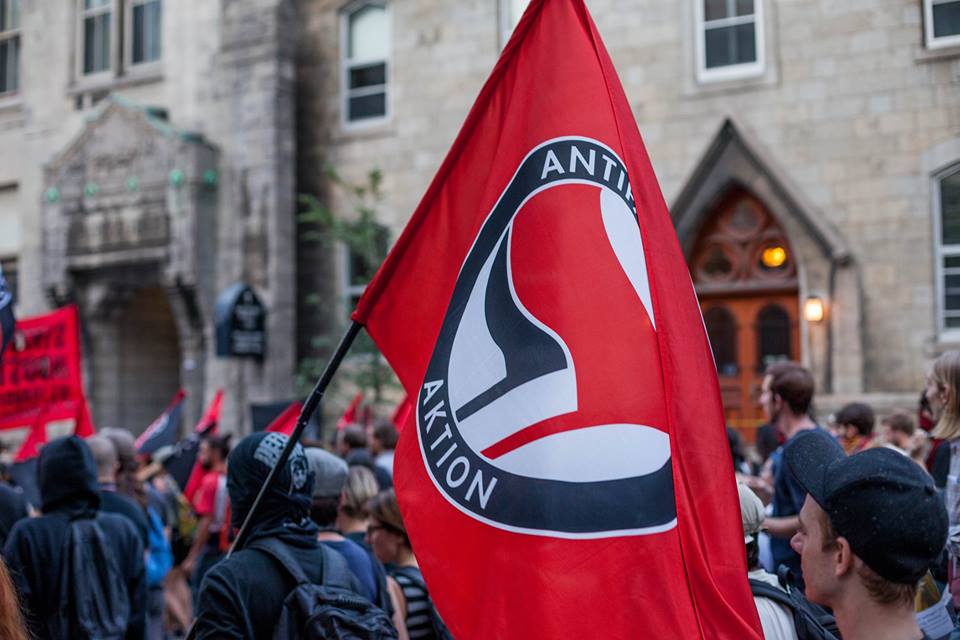
6 reasons why Chomsky is wrong about antifa
Noam Chomsky recently made some comments about
antifa, and militant anti-fascism in general, which were as ill-timed as
they were ill-informed. Here’s what we think he’s got wrong about the
subject.In the aftermath of Charlottesville, the spotlight has been turned
on the reality of fascist violence in America. The murder of Heather
Heyer is only the most recent in a year which has seen numerous other killings
(such as the two on the Portland MAX in May and Timothy Caughman in New
York City), with the 2015 killing of nine worshippers at Denmark
Vesey’s church in Charleston by Dylann Roof showing a continuity of
far-right violence long before the election of Donald Trump.Despite all this, many liberal talking heads have also decided that
now is the time to condemn those opposing the fascists. Perhaps the most
upsetting, has been the intervention of Noam Chomsky, given how important a figure he was to our politics when we were growing up. But what did Chomsky get wrong?1) Antifa’s ‘predecessors’ are more significant than Chomsky thinks
Chomsky describes Antifa as “a minuscule fringe of the Left, just as
its predecessors were” with “some limited similarity to the Weather
Underground”. While we might take issue with Chomsky’s description of
contemporary Antifa, another problem is his misrepresentation of its
“predecessors”.Antifa’s predecessors have almost nothing to do with the Weather Underground. Rather, they can be seen in the mass mobilisation against Mosley’s Blackshirts in Cable Street, East London, as well as less famous mobilisations in Manchester, Liverpool, Newcastle, Hulme and Stockton.
They are the 43 Group and the 62 Group,
Jewish-led organisations who took it upon themselves to smash Mosley’s
attempts to reorganise after the Second World War. They are in the mass
mobilisation of locals in Lewisham, South East London, in 1977, the Southall Youth Movement who fought skinheads in the streets and Anti-Fascist Action, who regularly routed fascists throughout the country from the mid-1980s to the late-1990s.In Europe, they are the Red Warriors of Paris or the Revolutionary Front in Sweden. And in North America they were the Teamsters who formed a defense guard against the Silver Shirts in the 1930s, or Anti-Racist Action who took on Klansmen and the National Socialist Movement from the 1980s until very recently.
None of these can or should be dismissed as easily as Chomsky seems to.
2) Antifa are ‘a major gift to the Right, including the militant Right, who are exuberant’?
When the extreme-right get smashed by anti-fascists, they are not exuberant.
When anti-fascists in Liverpool wiped the floor with the 2015 White
Man March in Liverpool, they were not exuberant; they were utterly
humiliated.When the English Defence League were chased out of Walthamstow in 2012, they were not exuberant, they were utterly humiliated.
The 43 Group, 62 Group and Anti-Fascist Action successfully disrupted
organised street fascism in the UK for decades after World War Two.In all these cases, physical defeats led to increased divisions in
the far-right, mutual recriminations and, most importantly, a puncturing
of the invincible street-fighter image these groups like to cultivate
for themselves.Of course they will try and spin every defeat as them being
victimised. But, they would just as much spin any unopposed march as a
successful show of force, especially if they go searching for targets
afterwards, as they have done in the past; ‘ignore fascists until they go away’ only works if you have the privilege of being ignored by them as well.A physical defeat is not a gift to the militant right; it is one of the most effective ways of keeping them weak.
Attendees of the ‘White Man March’ not
looking very exuberant as they hide in Liverpool Lime Street’s left
luggage department, 2015.3) Denying fascists a platform is not ‘wrong in principle’
Perhaps Chomsky’s most dangerous claim is that “What [antifa] do is
often wrong in principle – like blocking talks”. We say dangerous
because it encourages people to provide space for fascism to grow in.There is nothing wrong with denying fascists a platform, whether
these be rallies, demonstrations, public meetings or debates. Fascists
use their platforms to build strength and, as they grow stronger, to
attack their opponents.We are not duty-bound to give fascists somewhere to spread their
hate. In 2002, the train drivers’ union, Aslef, expelled a member who
had been a local election candidate for the far-right BNP. Perhaps
Chomsky thinks this is wrong? Perhaps they were duty bound to accept a
member who would sow divisions between white and non-white members?
Perhaps Aslef should have organised a public debate to hear him out?Fascists love it when liberals provide them with a platform. It helps
them spread their message so that they can build numbers and confidence
to crush their opponents – liberals included.These platforms – whether on city streets or in debate halls – should not be provided.
4) Street confrontations are not always won by ‘the toughest and most brutal’…
Chomsky claims “When confrontation shifts to the arena of violence,
it’s the toughest and most brutal who win – and we know who that is”.
Yet mass anti-fascist mobilisation can shut down fascists without being
‘the most brutal’. In Liverpool, fascists ran to hide in a train
station’s left luggage department after being outnumbered 10-to-1. In
Brighton, fascist marches have been made impossible without heavy police
escort due to mass local opposition.Ultimately, the most powerful force in society is the working class. We can always win when we turn out in force.
5) … and the far-right aren’t always ‘the toughest and most brutal’ anyway.
It is the stuff of far-right fairy tales that they have the monopoly
on using violence. The experience of Post-World War Two Britain is that
the far-right, for all their bluster, were not as ’good on the pavement’ as they thought they were. From the 43 Group to the 62 Group to AFA, the far-right were frequently beaten on the streets.While it is important that we focus on building mass, working-class
anti-racist movements rather than crack squads of elite anti-fascist
special forces, it’s also important not to perpetuate the myths which
the far-right perpetuate about themselves.6) Physical opposition to fascism does not negate ‘constructive activism’
Chomsky’s claim that one of the “costs” of physical confrontation
with fascists is the “loss of the opportunity for education, organizing,
and serious and constructive activism” is a false division. Moreover,
it’s one that shows a lack of real-life contact with anti-fascists.In reality, anti-fascists often are involved in activity beyond
‘anti-fascism’ whether that be migrant solidarity, union organising,
anti-police violence or whatever else. They hold film screenings,
concerts and football tournaments. The fact that Chomsky misses all this
says more about him than it does anti-fascists.If people are prepared to put their lives and safety on the line to
resist fascism that’s a choice which should be celebrated. Community
self-defense can create space for other organising to happen, whereas
un-opposed fascists will happily crash and disrupt left meetings and
organising.A big contingent of antifascist mobilisations in the US have been
associated with the IWW, a radical union which puts huge importance on
serious, constructive education and organising. You can organise at work
Monday to Friday and oppose fascists when they occasionally come to
town on Saturday, that’s not much of an ‘opportunity cost.’Ultimately, it’s important to remember that ‘anti-fascism’ will never
be enough to defeat fascism; in fact, there is no defeating fascism
without defeating capitalism. That means building a mass, working-class
political culture that stands as an alternative to both the far-right
and the liberal politics of ‘business as usual’: vibrant workplace
organisations both inside and out of traditional unions, community
groups fighting on housing, police brutality, proper provision for
survivors of domestic violence, migrant solidarity, and so much more it
couldn’t possibly fit here.We mustn’t think of antifa as an end in and of itself. But we don’t
need the left’s most prominent public intellectuals to throw them under
the bus either.
 QueerAnarchism